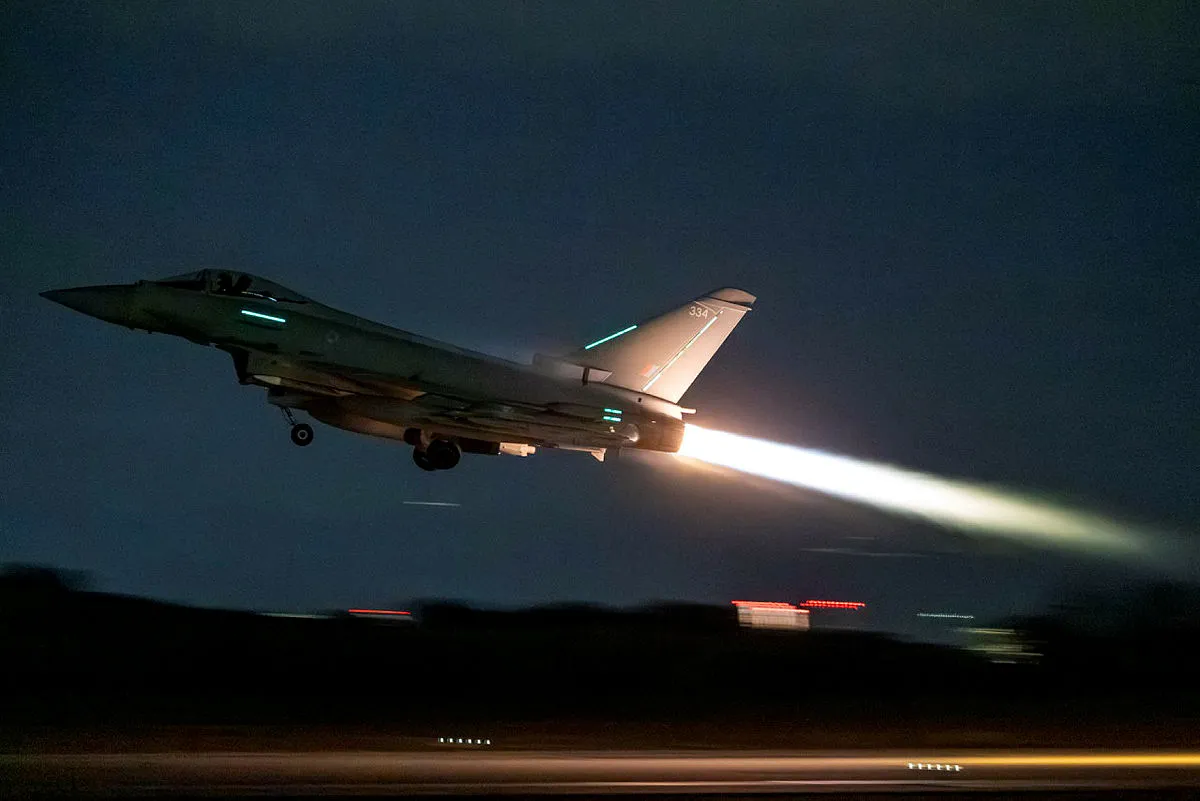
When an Iranian-made Shahed drone punched into the runway at RAF Akrotiri in the early hours of 2nd March 2026, it didn't just cause minor damage to a strip of tarmac on a British sovereign base in Cyprus. It caused something arguably more significant; it blew a hole in the comfortable fiction that decades of defence cuts had left us anywhere near ready for the world we actually live in.
For most veterans watching events unfold in real time — the frantic scramble to get F-35s airborne, personnel being told to shelter under "solid furniture," a Type 45 destroyer hastily ordered to the Eastern Mediterranean — the reaction was probably somewhere between grim satisfaction and jaw-dropping disbelief. Not surprise. Never surprise. Anyone who's served knows you can't run an armed forces on hope and headline figures.
The Numbers Don't Lie
Let's start with the basics, because the facts here are stark enough without any embellishment.
In 2010, the British Army stood at around 109,000 regular personnel. Army troop numbers, which stood at 109,000 in 2010, are now down to 72,500 — their lowest since the early 1800s. That's not a trimming. That's a structural gutting carried out across successive Conservative and Labour governments, all of whom found defence an easy target when the Treasury came knocking.
The total number of UK Regular Forces based in the UK decreased to 132,360 as of 1 April 2024, a notable decline from 156,970 in 2014 — a reduction of approximately 15.7% in just one decade. The Army and Navy have missed their recruitment targets every single year since 2010.
The Conservatives cut troop numbers by 10,000 when they were in government, reducing the size of the British Army to its smallest since the Napoleonic era. And lest anyone assume Labour have ridden to the rescue since July 2024, figures show that full-time trained Armed Forces personnel have dropped by a further 2,181 since the current government was elected.
So here we are. Two parties, decades, and one dismal trajectory.
A "Quick and Dirty Review" — Their Words, Not Ours
The rot really set in with the 2010 Strategic Defence and Security Review (SDSR). Conducted against a backdrop of financial crisis and two deeply unpopular wars, it was — by the frank admission of one of the ministers involved — widely accepted to have been driven by budget considerations, described by former Defence Minister Sir Nick Harvey as a "quick and dirty review."
The results were brutal. The number of Challenger 2 tanks was cut by 40% to just over 200. The number of AS-90 self-propelled heavy artillery guns was cut by 35%. The Royal Navy flagship HMS Ark Royal was decommissioned almost immediately. The Harrier fleet — the very aircraft that proved its worth in the Falklands — was retired, with 72 of them sold to the United States for spare parts.
That last fact still stings. Aircraft that had served with distinction, flogged off for components, while the carriers designed to replace their capability sat years from completion.
Real-terms defence spending fell by 22% between 2009/10 and 2016/17. Think about that for a moment. At a time when Russia was flexing its muscles in Crimea, when IS was carving a caliphate out of Iraq and Syria, and when Iran was accelerating its regional ambitions — Britain was cutting its armed forces to the bone.
The Hollowing Out
The equipment shortfalls that followed weren't just embarrassing — they were dangerous. Britain has drastically reduced its numbers of tanks, planes, ships, armoured vehicles and airlift helicopters. Its missile defences are inadequate to defend its own territory from attack. It has abandoned its major landing craft, meaning that an operation like that to retake the Falkland Islands in the Eighties would now be extremely difficult.
The Ajax armoured vehicle programme — the Army's long-awaited replacement for vehicles that entered service over 50 years ago — was originally due for delivery in 2017 but has repeatedly been delayed due to design flaws that caused illness and hearing problems in soldiers. Scimitar and Scorpion vehicles from the 1970s are still doing the rounds. The equipment budget has been, to put it bluntly, a national embarrassment.
Senior voices within the military saw all of this coming and said so. The UK's former Chief of the General Staff, General Sir Patrick Sanders, repeatedly warned that defence cuts risk leaving the UK unprepared for war and lacking the capability to launch operations such as the 2003 invasion of southern Iraq. In 2024, the House of Lords International Relations and Defence Committee said it was concerned that the Army would not be able to meet the expected troop contribution to NATO, questioning whether the British Army is prepared to meet the growing threat posed by Russia to European security.
These weren't fringe voices. These were the people who knew, because it was their job to know.
What Happened at Akrotiri
Against that backdrop, consider what unfolded over this past weekend.
On 28 February, Iran was struck by Israeli-American airstrikes. In response, Iran began launching strikes against various regional countries. Initially, Prime Minister Keir Starmer said Britain would stay out of it. Then, as Iran's retaliation escalated and British allies in the Gulf came under fire, the government agreed to let the US use UK bases — for strikes on Iranian missiles and launch sites, but excluded use for strikes on political and economic targets in Iran.
Within hours of that announcement, a drone hit the runway at RAF Akrotiri. There were no injuries and minimal damage, but the strike brought the conflict onto EU soil.
Sources said the attack was a "wake-up call for the United Kingdom."
Wake-up call. There's a phrase that should make every veteran wince. Because the alarm has been ringing for fifteen years.
The entirely predictable lack of ground-based air defence and critical infrastructure protection at the base left Akrotiri personnel being told to find some "solid furniture" to hide behind. One defence commentator called it, with admirable restraint, "nothing short of treason that this base is indefensible."
In response, the Prime Minister confirmed that two Wildcat helicopters would be deployed to Cyprus for counter-drone capability, along with a Type 45 Air Defence Destroyer to the Eastern Mediterranean. The right move — but reactive, scrambled, and weeks too late. As any soldier will tell you, you don't start drawing up the battle plan after the rounds start landing.
The Veteran's View
There's a particular kind of frustration that veterans feel watching all of this — not rage, exactly, but something closer to weary, embarrassed recognition.
You've seen it before. You've served in theatres where the kit was inadequate, the numbers were stretched, and the blokes and women on the ground were expected to compensate with professionalism and ingenuity for decisions made by people who'd never worn a uniform in their lives. You've watched the MOD fight wars on a peacetime procurement cycle. You've done more with less until "more with less" became an organisational philosophy rather than a temporary fix.
What's different now is that the world has finally caught up with the consequences of that approach. The idea — fashionable through the 2010s — that Britain could maintain a global security posture on a hollowed-out military, relying on "smart" capabilities and alliances to paper over the gaps, has been comprehensively tested. It hasn't held up.
In 2014, former US Defence Secretary Robert Gates stated that Britain would soon lack "the ability to be a full partner as they have been in the past." He was right. The embarrassment is that it took an Iranian drone hitting British sovereign soil for the political class to start taking the warning seriously.
Now What?
The Strategic Defence Review, published in June 2025 and endorsed by the current government, has at least acknowledged the scale of the problem. It was independently led by former NATO Secretary General Lord Robertson, with the government accepting all 62 of its recommendations. There are commitments to grow the fleet, rebuild capacity, and increase the defence budget toward 2.5% of GDP.
Words on paper. And we've heard words on paper before.
The test will be whether any of this translates into real capability — boots, kit, ships, missiles, and the infrastructure to support them — before the next crisis forces another emergency scramble. Veterans know that building military capability takes years, not weeks. The politicians who cut it all away did so quickly enough. Rebuilding is the work of a decade, not a parliamentary term.
In the meantime, the lads and lasses at Akrotiri are doing what British service personnel always do - getting on with it, professionally and without complaint, in a situation they didn't create and weren't adequately resourced for.
That, at least, hasn't changed.